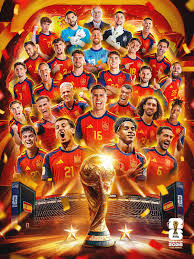
- Ferran Torres’ 106th-minute strike crowns La Roja world champions as Messi’s title defence ends in heartbreak
Spain were crowned champions of the world for the second time on Sunday after defeating defending champions Argentina 1-0 in a gripping extra-time final at the New York New Jersey Stadium in East Rutherford, New Jersey, ending Argentina’s dream of becoming the first nation in 64 years to successfully defend the FIFA World Cup title.
The dramatic victory, sealed by substitute Ferran Torres’ clinical finish in the 106th minute, marked Spain’s first FIFA World Cup triumph since their historic 2010 success in South Africa and confirmed the emergence of a new football dynasty under head coach Luis de la Fuente.
Torres, introduced from the bench to inject fresh attacking energy, became Spain’s unlikely hero when he volleyed home after a well-worked move involving Pedro Porro and Nico Williams, finally breaking the resistance of Argentina goalkeeper Emiliano Martínez, who had produced a series of outstanding saves throughout the encounter.
Spain’s Total Domination
Although the scoreline suggested a closely fought contest, the statistics painted a completely different picture.
Spain dominated virtually every aspect of the final, producing one of the most commanding displays ever witnessed in a FIFA World Cup championship match.
Luis de la Fuente’s side registered an astonishing 20 attempts on goal, with 12 efforts on target, relentlessly attacking Argentina from the opening whistle until the winning goal finally arrived.
In contrast, the defending champions struggled throughout the contest, managing only two attempts during the entire 120 minutes and failing to record a single shot on target—a remarkable statistic for a team seeking consecutive World Cup titles.
Spain’s patient possession-based football, aggressive pressing and tactical discipline suffocated Argentina, preventing Lionel Messi and his teammates from establishing any meaningful attacking rhythm. The South Americans were forced deep into their own half for long periods, relying almost exclusively on Martínez’s brilliance to remain in the match.
Argentina entered the final carrying the hopes of becoming only the third nation in football history to retain the FIFA World Cup.
Only Italy (1934 and 1938) and Brazil (1958 and 1962) had previously defended the trophy successfully.
However, Spain ensured that record remained untouched.
The defeat also ended Lionel Messi’s pursuit of a second World Cup crown, bringing to a painful conclusion what is widely expected to be his final appearance on football’s biggest stage.
The triumph represents another golden chapter in Spanish football.
Having captured the UEFA European Championship in 2024, Spain has now completed a remarkable Euro 2024–FIFA World Cup 2026 double, confirming La Roja as the dominant force in international football.
Under Luis de la Fuente, Spain blended youthful brilliance with tactical maturity, producing a team capable of controlling matches through possession while remaining defensively resolute.
The Spaniards conceded only one goal throughout the entire tournament, establishing one of the finest defensive records in FIFA World Cup history.
Spain’s victory elevates them into the exclusive group of multiple FIFA World Cup winners.
Since the tournament began in 1930, only eight nations had previously won the title. With Sunday’s triumph, Spain doubled its tally from one championship to two, joining Uruguay and France among nations with multiple World Cup crowns.
The all-time FIFA World Cup winners now stand as:
Brazil – 5 titles
Germany – 4
Italy – 4
Argentina – 3
Spain – 2
France – 2
Uruguay – 2
England – 1
The result also prevented Argentina from equalling Germany and Italy on four World Cup titles.
For Spain, the victory signals the arrival of another golden generation, echoing the legendary team that conquered Europe in 2008 and 2012 and won the World Cup in 2010.
Built around technical excellence, tactical intelligence and fearless young talents, this Spanish side demonstrated throughout the tournament why many consider it the benchmark for modern international football.
As captain and coach lifted the famous FIFA World Cup trophy before a capacity crowd in New Jersey, Spain celebrated not just another championship but the confirmation of a football renaissance.
For Argentina, it was the end of a dream to become back-to-back world champions.
For Spain, it was the beginning of a new chapter in football history—a chapter written through patience, dominance and a single unforgettable strike from Ferran Torres that restored La Roja to the summit of world football.