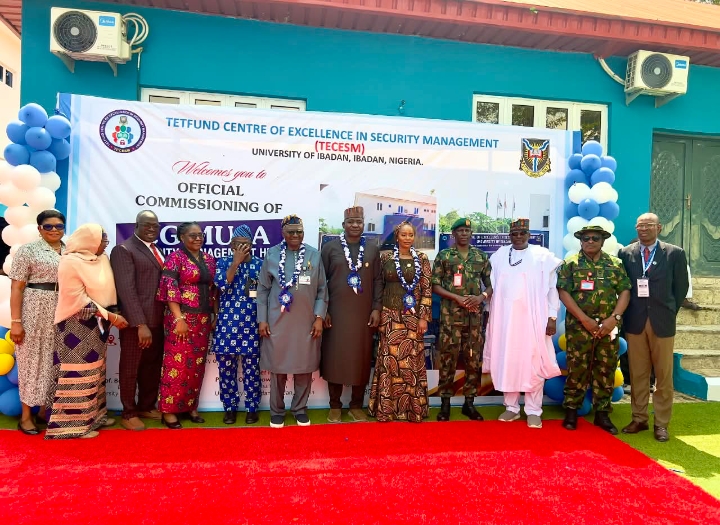
…Musa identifies arms and ammunition shortages as major obstacles, advocates local production, technological innovation and stronger university-security collaboration
The Minister of Defence, Major General (Rtd) Christopher Musa, has said Nigeria has intensified efforts to tackle insecurity, with gradual improvements being recorded, while identifying inadequate access to weapons and ammunition as one of the factors prolonging the country’s security challenges.
Musa, who spoke on Friday at the University of Ibadan (UI), stressed that addressing insecurity requires more than military operations, calling for informed policies, credible institutions, technological innovation and a deeper understanding of the human dimensions of conflict.
The Minister made the remarks at the commissioning of the CG Musa Security Management Hub, a facility he donated to the TETFund Centre of Excellence in Security Management at the University of Ibadan.
He described the academic community as a critical component of Nigeria’s national security architecture, noting that universities provide the intellectual environment needed to investigate the root causes of insecurity, assess existing interventions and develop sustainable solutions.
According to him, while the battlefield exposes the immediate manifestations of insecurity, universities offer opportunities for research, critical analysis and evidence-based policy development.
Musa identified the increasing difficulty of procuring military equipment and ammunition as a major challenge confronting Nigeria’s security operations, arguing that the country must strengthen its domestic defence manufacturing capacity.
He explained that despite having funds available, Nigeria sometimes struggles to obtain essential military equipment from international suppliers because of supply constraints and competing global demands.
The Minister said ongoing conflicts in different parts of the world, particularly the Russia-Ukraine war and tensions around the Strait of Hormuz, had further complicated international procurement of defence equipment.
He stated:
“Our intention is to expose our local producers to foreign and international manufacturers so that we can continue to produce what we need or what we rely on. Why insecurity continues to be prolonged is that we do not produce all we need.
“Most times, when we go to buy, even with cash at hand, you can’t get them off the shelves. And now, with the wars going on in Ukraine, Russia and the Strait of Hormuz, it has become extremely difficult buying as little as ammunition to use, let alone APCs.
“Since our local manufacturers are doing their best, we need to escalate to an international level.”
He said Nigeria must therefore deepen collaboration between domestic defence manufacturers and international partners to improve local production, reduce dependence on foreign suppliers and ensure more reliable access to essential military equipment.
Describing the country’s security challenges as increasingly complex, interconnected and multidimensional, Musa identified extremism, weak governance, political manifestations and social exclusion among the underlying conditions sustaining insecurity.
He maintained that the challenges could not be resolved through military operations alone.
According to him, addressing the root causes requires coordinated interventions involving government institutions, security agencies, researchers, technology experts and communities.
The Minister also disclosed that the military had stepped up its operational efforts and was gradually improving the security situation, while urging Nigerians to embrace collective responsibility in the fight against insecurity.
“We have stepped up our game in the field and are gradually improving the security situation. It is also important that everybody plays a part because it is a whole-of-nation approach. If you see something, say something,” he said.
Musa reaffirmed the Federal Government’s commitment to strengthening collaboration between defence institutions and academic centres, explaining that research, innovation and evidence-based analysis should inform national security policies and operational strategies.
He said such partnerships would help ensure that security interventions were not based solely on immediate operational experiences but also on rigorous research and a proper understanding of the factors driving conflict.
In his remarks, the Vice-Chancellor of the University of Ibadan, Professor Kayode Adebowale, thanked the Minister for providing the facility, describing it as an investment that would benefit both present and future generations of researchers and security professionals.
Adebowale assured that the university would ensure the facility was effectively utilised to strengthen the TETFund Centre of Excellence in Security Management and advance its ambition of becoming a leading centre for security research in Africa.
He expressed the hope that the hub would serve as a platform for multidisciplinary research and a meeting point for policymakers, academics and other stakeholders in the security sector.
The Vice-Chancellor emphasised that the facility must go beyond being a repository of security-related materials to become a functional research centre capable of generating data and policy recommendations for the Ministry of Defence and security agencies.
“We hope and believe that this hub serves as the nexus for multidisciplinary research and as a convening ground for policymakers and academics. The facility must not become a museum of security artefacts but must be used to generate data that will guide the Ministry of Defence and our security agents,” he said.
The Lead Researcher and Technical Officer at the Centre, Professor Isaac Olawale Albert, commended the Defence Minister for fulfilling his promise to the institution through the donation of the facility.
Albert, however, urged the Minister to facilitate increased funding for the TETFund Centre of Excellence in Security Management to enable it to undertake more research, implement relevant projects and generate findings capable of informing effective national security policies.
He also called on security agencies to establish stronger working relationships with the Centre by patronising its research services and engaging its pool of experts in the formulation and implementation of security policies.
According to him, closer collaboration between researchers and security institutions would help bridge the gap between academic findings and practical security operations.
Earlier in his welcome address, the Director of the TETFund Centre of Excellence in Security Management, Professor Benjamin Aluko, appreciated the Minister for donating the building to the Centre.
Aluko also encouraged interested Nigerians to enrol in the Centre’s Master of Science (MSc) and PhD programmes in Security Management at the University of Ibadan.
He said the programmes provide opportunities for participants to benefit from the expertise of experienced academics and specialists in security management.
The commissioning of the CG Musa Security Management Hub is expected to strengthen the Centre’s capacity to promote research, professional training and policy engagement in response to Nigeria’s evolving security challenges.
Nigeria Intensifies Fight Against Insecurity, Records Gradual Improvement – Defence Minister