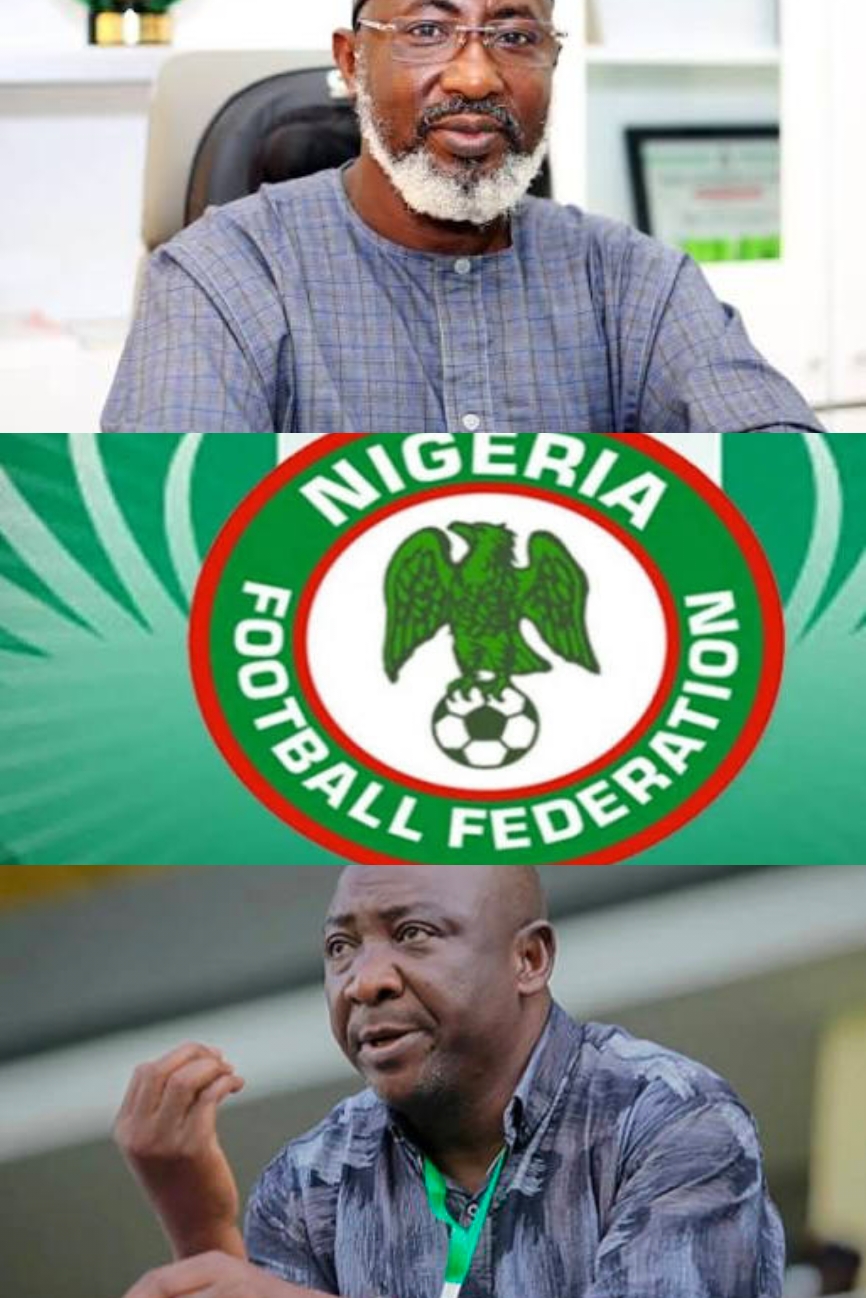
…Why NFF leadership finally quit — Super Eagles’ World Cup failures, historic Falcons setback, security investigations, frozen relationship with NSC, looming September election
By Debo Adeoye | Investigative Sports Desk | Ibadan
The resignation of Nigeria Football Federation (NFF) President, Ibrahim Musa Gusau, General Secretary Dr Mohammed Sanusi and members of the federation’s Executive Committee on Thursday, August 27, 2026, did not happen in isolation.
It was the culmination of several weeks of mounting pressure in which Nigerian football found itself caught between sporting failure, financial scrutiny, political intervention, internal fragmentation and the international requirement that football associations remain autonomous from government interference.
What initially looked like a dispute over poor results gradually developed into a full-blown governance crisis at the Glass House.
By the time Gusau and Sanusi finally stepped aside, reports indicated that as many as eight of the 13 members of the NFF board had already resigned, leaving the administration increasingly weakened from within.
The resignation is therefore better understood not as a single decision triggered by one event, but as the end product of a convergence of pressures that progressively stripped the Gusau administration of political, public and institutional room to manoeuvre.
And therein lies the bigger story.
THE FIRST CRACK: NIGERIA’S FOOTBALL RESULTS COLLAPSE
For an organisation whose primary responsibility is to develop and administer football, the most damaging indictment against the Gusau administration was ultimately written on the pitch.
The Super Eagles failed to qualify for the 2026 FIFA World Cup, meaning Nigeria missed the tournament for a second consecutive edition after also failing to make Qatar 2022.
But the crisis became considerably more serious when the Super Falcons failed to qualify for the 2027 FIFA Women’s World Cup.
Nigeria had appeared at every edition of the Women’s World Cup since the tournament began in 1991. The failure to qualify for Brazil 2027 therefore represented an unprecedented break with that history.
The Falcons’ problems intensified after their 1-0 defeat to Cameroon in the 2026 Women’s Africa Cup of Nations quarter-final, which ended their title defence and complicated their route to World Cup qualification.
Nigeria subsequently lost 2-1 to South Africa in the decisive qualification playoff, bringing the country’s historic World Cup attendance streak to an end.
The significance was enormous.
Nigeria had traditionally been able to count on the Super Eagles and Super Falcons as reliable ambassadors of the country’s footballing strength. Suddenly, the two flagship senior teams were absent from the world’s biggest men’s and women’s tournaments.
That transformed criticism of the NFF from ordinary football dissatisfaction into a national governance issue.
WHEN PUBLIC ANGER BECAME POLITICAL PRESSURE
Calls for the NFF leadership to resign had already been growing before the latest crisis.
Former NFF Vice-President Gabriel Chukwuma was among those publicly demanding that the board take responsibility for what he regarded as the deterioration of Nigerian football.
The pressure escalated sharply in August.
Reports emerged that the National Sports Commission (NSC) had given the NFF leadership a 24-hour ultimatum to resign over allegations including maladministration, misappropriation and poor judgement.
But the story contained an important contradiction.
An NFF board member, Nse Essien, dismissed the reported ultimatum as “fake news”, while the NSC itself subsequently denied that the Federal Government had formally ordered the NFF leadership to resign. The NSC said instead that consultations were ongoing about how to re-engineer Nigerian football.
That distinction is important.
There was, at least publicly, no documented government order announcing the removal of the elected NFF president.
Yet, behind the official denials, the political pressure was clearly intensifying.
The Guardian reported that the NSC and other government organs were considering a normalisation committee to manage the federation while fundamental problems were addressed.
The question then became: How could the Federal Government exert pressure without triggering FIFA sanctions for political interference?
That question ultimately became central to the entire crisis.
THE ₦17 BILLION QUESTION
Perhaps the most consequential development occurred away from the football pitch.
The NFF came under scrutiny over a massive Federal Government intervention fund approved in 2024 to clear outstanding payments owed to Nigeria’s national teams.
Different reports have cited ₦12 billion and ₦17 billion, apparently reflecting differing descriptions of the intervention and amounts under investigation. The most recent security reporting refers to ₦17 billion, while a Punch report described an investigation into a ₦12 billion intervention fund.
That discrepancy itself deserves clarification by the relevant government authorities and the NFF.
What is not in dispute is that Federal Government money was released to address outstanding obligations involving players and national teams, and that the utilisation of the funds subsequently came under investigation.
The Economic and Financial Crimes Commission (EFCC) and Independent Corrupt Practices and Other Related Offences Commission (ICPC) began examining the utilisation of the intervention money.
Punch reported that some NFF officials had been invited by investigators, had given statements and were subsequently on administrative bail while the investigation continued.
The NFF, in response to a Freedom of Information request, reportedly indicated that relevant records were already with the EFCC and ICPC.
This is a crucial distinction:
An investigation is not proof of financial wrongdoing.
No conviction or final finding of culpability against Gusau, Sanusi or any other NFF official has been established in the material reviewed for this report.
But politically, the existence of an active investigation was damaging enough.
It meant the NFF leadership was no longer dealing solely with angry football supporters. It was now facing scrutiny from Nigeria’s financial and law-enforcement institutions.
THEN THE DSS ENTERED THE PICTURE
The crisis took another dramatic turn when the Department of State Services (DSS) reportedly began examining the federation’s handling of the intervention funds.
Vanguard reported that the DSS was seeking documentation from NFF officials concerning the utilisation of the money. The report quoted a source who described the exercise as a normal examination of documents rather than a witch-hunt.
But another development made the situation considerably more sensitive.
The Guardian reported on August 25 that the DSS and National Intelligence Agency (NIA) were investigating allegations that some senior NFF officials had links with foreign interests in circumstances authorities considered potentially relevant to national security. The report said the alleged intelligence investigation went beyond the financial issue.
Again, these are allegations under investigation, not established facts.
But their emergence dramatically changed the atmosphere surrounding the federation.
A football administration already struggling to explain sporting failures was now operating under the shadow of financial and intelligence investigations.
THE BOARD BEGAN TO BREAK APART
The pressure was not confined to Gusau.
Reports indicated that members of the Executive Committee began leaving their positions, with eight of the 13 board members reportedly having resigned before Thursday’s mass exit.
That development was potentially more damaging to the administration than criticism from outside.
An elected football leadership can survive hostile public opinion if its internal structure remains intact.
But once its own governing body begins to fragment, its ability to make decisions, defend its policies and organise an election becomes severely compromised.
The September 27 NFF election, which had been scheduled to take place in Lafia, Nasarawa State, was consequently thrown into uncertainty.
Gusau had reportedly been seeking another term.
Instead, the administration that was supposed to conduct the transition was itself becoming the subject of a transition.
THE FINAL DOMINO: GUSAU AND SANUSI EXIT
On August 27, the crisis reached its decisive point.
Reports from multiple Nigerian media organisations confirmed that Gusau had resigned, alongside other Executive Committee members.
More significantly, Mohammed Sanusi, the NFF General Secretary, also confirmed his own resignation. The former chief scribe told Daily Sun that the resignation of both himself and Gusau was true.
The significance of Sanusi’s departure cannot be underestimated.
The NFF president is the federation’s political head, but the General Secretary is the administrative engine of the organisation.
The simultaneous departure of both men effectively removed the top political and administrative leadership of the federation.
Daily Sun described the development as unprecedented in the history of Nigerian football administration.
WAS IT REALLY A VOLUNTARY RESIGNATION?
This is where the evidence requires careful interpretation.
Gusau reportedly denied being under pressure as recently as Wednesday while speaking at the unveiling of the Nigerian Premier Football League.
Yet, within approximately 24 hours, he and Sanusi had resigned.
That extraordinary sequence raises the central investigative question:
Did the NFF leadership resign voluntarily—or resign because the alternatives had effectively disappeared?
The evidence points strongly toward the latter interpretation politically, although the exact legal circumstances of each resignation remain unclear.
There was no public document available at the time of this report showing a formal government removal order.
What is clear is that the leadership was facing:
• mounting public anger; • two successive men’s World Cup failures; • the historic Falcons World Cup qualification failure; • an active financial investigation; • DSS scrutiny; • reports of an intelligence investigation; • internal board defections; • an increasingly hostile relationship with the NSC; and • uncertainty over the forthcoming NFF election.
The cumulative effect was enormous.
In political terms, a resignation under such circumstances may be formally voluntary while being substantively compelled by circumstances.
THE FIFA DILEMMA: GOVERNMENT CAN’T SIMPLY TAKE OVER
This is perhaps the most delicate aspect of the crisis.
The Federal Government has legitimate reasons to demand accountability when public funds are involved and when the country’s flagship national teams suffer major failures.
But the NFF is also a member association of FIFA.
And FIFA’s statutes require member associations to manage their affairs independently and ensure that their affairs are not influenced by third parties. FIFA’s statutes also provide for sanctions where these obligations are seriously breached.
This means Abuja cannot simply dissolve the NFF leadership, appoint its own football administrators and expect the international football community to accept the arrangement.
The danger is FIFA suspension.
Nigeria has seen this issue before, and FIFA has previously demonstrated that government intervention can trigger suspension proceedings against national associations. FIFA’s own historical records contain examples of member associations being threatened with suspension over third-party interference.
Consequently, the most politically sensible solution for Abuja would be one that is coordinated with FIFA and conducted within football’s own statutes.
NORMALISATION COMMITTEE: THE NEXT BATTLE
This is where the proposed normalisation committee becomes important.
A normalisation committee is not simply a government-appointed caretaker board. In FIFA practice, such mechanisms can be used to stabilise a troubled association, review statutes and electoral processes, and organise elections under an agreed framework.
But the key word is FIFA.
If Abuja appoints a committee unilaterally, it could be interpreted as government takeover.
If FIFA approves or mandates an appropriate normalisation process, the arrangement becomes much easier to reconcile with football’s autonomy rules.
FIFA has previously used normalisation committees in member associations to restore governance and organise elections.
The real contest, therefore, may now shift from:
“Who replaces Gusau?”
to:
“Who controls the process of replacing Gusau?”
WHERE DOES CAF STAND?
The Confederation of African Football (CAF) is also inevitably involved, although an important distinction must be made.
There is no publicly available CAF statement, as of the publication of this report, announcing that CAF ordered, demanded or endorsed the resignation of Gusau, Sanusi or the NFF board.
Indeed, the most recent CAF material reviewed continues to identify Gusau as NFF president in its member-association profile, while CAF’s April 2026 statement concerning the death of former NFF president Ibrahim Galadima referred to Gusau as the sitting NFF president.
There is therefore no responsible basis for claiming that CAF engineered the resignations.
But CAF will be important in what comes next.
Nigeria is one of Africa’s most significant football nations, and any governance crisis affecting its national teams and participation in CAF competitions has continental consequences.
CAF also operates within the broader FIFA governance framework.
Consequently, any solution designed to stabilise Nigerian football would need to take account of both FIFA requirements and CAF’s continental competition framework.
AND WHAT HAS FIFA ACTUALLY SAID?
This is another area where speculation has outrun confirmed evidence.
There have been reports that the Nigerian authorities communicated with FIFA about the possibility of a normalisation process, and suggestions that FIFA’s leadership had given assurances concerning the way forward.
However, no official FIFA statement located for this report confirms that FIFA authorised the Nigerian Government to remove the NFF leadership, nor has FIFA publicly endorsed the mass resignation.
That distinction is vital.
What FIFA’s statutes clearly establish is the principle of member-association autonomy.
FIFA’s legal framework also provides disciplinary mechanisms for violations and has repeatedly treated third-party interference as a serious governance matter.
Therefore, FIFA’s likely concern is not necessarily whether Gusau remains president.
Its fundamental concern is whether the process by which Nigerian football leadership is replaced complies with the NFF statutes and FIFA’s governance requirements.
In other words, FIFA can accept a change of leadership.
What it cannot casually accept is government control of the football federation.
THE INFANTINO FACTOR
There is also a political dimension that requires careful handling.
FIFA President Gianni Infantino has recently faced criticism and political resistance from sections of European football over several governance and commercial issues.
FIFA itself issued a statement on August 8 rejecting what it described as attempts to undermine its president and insisting that the FIFA President’s mandate comes from its member associations and established democratic processes.
Against that international backdrop, speculation has circulated about the relationship between the Nigerian Government, the NFF leadership and the FIFA hierarchy.
However, this investigation has found no independently verified evidence establishing that Nigeria’s handling of the NFF crisis was linked to any alleged support for Infantino’s political interests.
Such claims should therefore remain in the category of political speculation unless documentary evidence emerges.
WHAT DOES THIS MEAN FOR NIGERIAN FOOTBALL?
The immediate challenge is not merely replacing Gusau.
It is rebuilding an institution whose credibility has suffered a serious blow.
The next administration will inherit:
• a national men’s team absent from two successive World Cups; • a women’s national team that has missed its first World Cup; • financial questions involving government intervention funds; • investigations by law-enforcement agencies; • a fractured Executive Committee; • an unsettled electoral process; • strained relations between the federation and the NSC; and • an urgent need to restore confidence among players, coaches, clubs, sponsors and supporters.
This is therefore bigger than one president.
THE THREE POSSIBLE PATHS FORWARD
OPTION ONE: FIFA-BACKED NORMALISATION
The Federal Government, FIFA and CAF could agree on a temporary normalisation mechanism tasked with reviewing the federation’s governance structure, resolving outstanding issues and conducting fresh elections.
This would arguably offer the cleanest route if properly negotiated.
OPTION TWO: RAPID NFF ELECTION
The federation could attempt to preserve its statutory autonomy by allowing the NFF Congress to conduct a fresh election under its own constitution and applicable FIFA rules.
But with much of the previous board gone, the electoral process itself may require clarification.
OPTION THREE: GOVERNMENT-NFF CONFRONTATION
The most dangerous scenario would be a unilateral government takeover followed by resistance from FIFA.
That could produce a direct conflict between Nigeria’s sovereign authority and football’s international autonomy rules, potentially placing Nigeria’s national teams and clubs at risk of international sanctions.
THE QUESTIONS THAT STILL NEED ANSWERS
The resignation may have ended the Gusau era, but it has not answered the questions that produced the crisis.
Who authorised the ₦17 billion intervention?
Exactly how much was released—₦12 billion or ₦17 billion—and were these separate tranches or different descriptions of the same intervention?
How much was ultimately spent?
How much was paid directly to players and officials?
What remains outstanding?
What have the EFCC and ICPC established so far?
Why did the DSS become involved?
Are the reported intelligence allegations substantiated or merely preliminary leads?
Who authorised the proposed restructuring of the NFF?
Was FIFA formally consulted before the resignations?
Will FIFA approve a normalisation committee?
Who will conduct the next NFF election?
And, most importantly, will the process be genuinely independent of government interference?
Until these questions are answered, the resignation of Gusau and his board should not be presented as the conclusion of the crisis.
It is only the first act of the next chapter.
THE BIGGER PICTURE
The collapse of the Gusau administration exposes a fundamental contradiction in Nigerian football.
The government finances significant aspects of the national football system and is politically accountable when national teams fail. Yet FIFA insists that the national federation must operate autonomously.
The NFF, meanwhile, sits between those two forces—dependent on government support but constitutionally required to operate independently.
For years, this tension has remained manageable.
In August 2026, it finally exploded.
The immediate catalyst may have been the Super Falcons’ historic World Cup failure. The financial investigations may have supplied the pressure from another direction. The reported board defections weakened the administration internally. The NSC’s intervention changed the political equation.
But the deeper issue is institutional.
Nigeria now has to decide whether it merely wants new football administrators—or whether it is prepared to build a football governance system in which sporting performance, public money, accountability and FIFA autonomy can coexist.
That is the real test after Gusau.
And this time, simply changing the occupants of the Glass House may not be enough.
Editorial Note on Verification
This report distinguishes between confirmed resignations, published allegations and unverified claims. As of August 27, 2026, multiple Nigerian media outlets have confirmed the resignations of Gusau and Sanusi, while reports indicate the wider Executive Committee has also stepped down. However, I found no official FIFA or CAF statement specifically endorsing or ordering the resignations*l. FIFA’s published statutes clearly establish the autonomy requirement, while CAF’s currently available official material confirms Gusau’s previous position but does not attribute the resignation to CAF.
NFF Leadership Collapse: How World Cup Failures, ₦17bn Probe, Government Pressure Forced Gusau, Sanusi Out