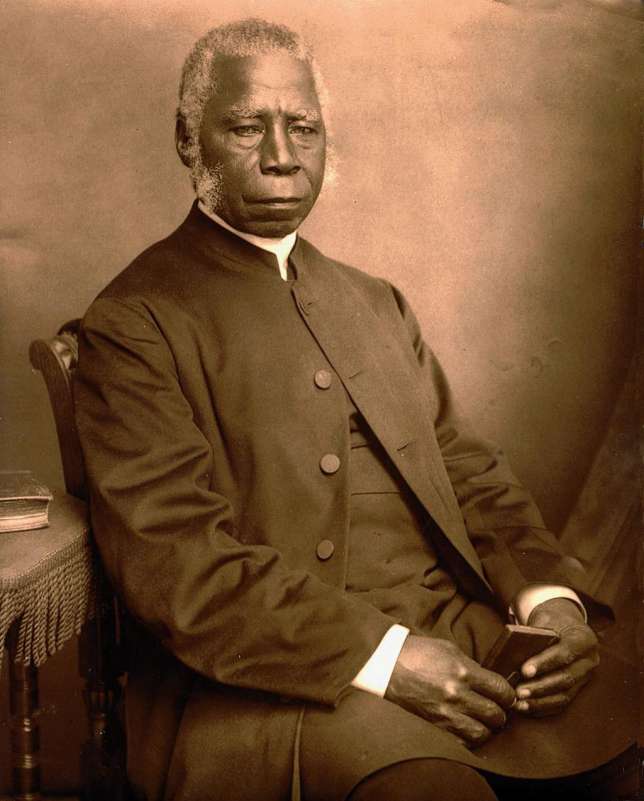
…Archbishop Justin Welby says Crowther was “betrayed, let down, undermined” despite his extraordinary missionary achievements
The Church of England has formally acknowledged and apologised for the historic injustice suffered by Bishop Samuel Ajayi Crowther, the pioneering Nigerian clergyman who became the first African bishop in the Anglican Church and one of the most influential Christian missionaries in 19th-century West Africa.
The apology was delivered by then Archbishop of Canterbury Justin Welby at Canterbury Cathedral during a Service of Thanksgiving and Repentance on June 29, 2014, marking the 150th anniversary of Crowther’s consecration. It was not a recent apology, as some versions of the story circulating online suggest.
Welby acknowledged that Crowther had been properly consecrated as a bishop but was subsequently subjected to racial prejudice, undermining and institutional opposition within the missionary establishment.
“We in the Church of England need to say sorry that someone was properly and rightly consecrated Bishop and then betrayed and let down and undermined. It was wrong.”
The Archbishop described the occasion as one of both “thanksgiving and repentance”, saying the Church needed to confront the “shame and sorrow” associated with the actions of some of its predecessors.
The historic acknowledgement has gained renewed attention as scholars, churches and institutions continue to reassess Crowther’s extraordinary life, the role of racism in 19th-century missionary activity and the treatment of African Christian leaders during the colonial era.
From enslaved boy to pioneering African bishop
Samuel Ajayi Crowther’s life remains one of the remarkable stories of the 19th-century Christian movement in Africa.
Historical sources place his birth around 1806/1807, at Osogun in what is now Oyo State, Nigeria. As a child, he was captured during the upheavals associated with the Yoruba wars and sold into the transatlantic slave trade.
He was subsequently liberated by the British Royal Navy’s West Africa Squadron, which intercepted the slave ship carrying him.
Crowther was taken to Sierra Leone, where he received education and encountered Christianity. He eventually became a teacher, catechist, linguist and Anglican clergyman.
Oxford historians describe him as probably the most prominent African involved in 19th-century missionary activity, noting that his journey from enslavement to the episcopacy illustrates the profound changes produced by emancipation, education and Christian missionary activity in West Africa.
His experiences as a formerly enslaved African also profoundly shaped his intellectual and missionary outlook.
Crowther’s extraordinary linguistic achievements
Crowther was far more than a church administrator.
He was a linguist, translator, scholar, teacher, author and missionary whose command of African languages became one of his greatest instruments for spreading Christianity.
He worked extensively on Yoruba, producing a Yoruba vocabulary and other educational materials and contributing substantially to the translation of Christian texts.
His work included a Yoruba translation of the Bible and a Yoruba version of the Book of Common Prayer. He also produced linguistic materials in Igbo and Nupe.
This work was significant because it challenged the assumption prevalent among many European missionaries of the period that Christianity had to remain primarily dependent on European languages and European personnel.
Crowther demonstrated that African languages could serve as sophisticated vehicles for Christian theology, education and scholarship.
The historic breakthrough of 1864
Crowther’s greatest ecclesiastical breakthrough came in 1864.
On June 29, 1864, he was consecrated Missionary Bishop of the Niger Territory at Canterbury Cathedral by Charles Longley, the then Archbishop of Canterbury.
He became the first African to attain the rank of bishop in the Anglican Church.
His consecration was a landmark moment for Christianity in Africa and a major challenge to prevailing European racial assumptions.
Crowther had already demonstrated extraordinary ability as a missionary and linguist, but his elevation to the episcopacy was particularly significant because many Europeans of the period questioned whether Africans were capable of occupying senior ecclesiastical positions.
His appointment therefore carried significance beyond the church.
It was also a challenge to the racial hierarchy of Victorian-era European society.
That Crowther was a formerly enslaved African who became a bishop of the Church of England made the achievement even more remarkable.
Oxford recognised his scholarship
In the same year as his episcopal consecration, Crowther was awarded an honorary Doctor of Divinity (D.D.) by the University of Oxford.
The recognition reflected his growing reputation as a scholar, linguist and missionary.
He had participated in expeditions along the Niger and developed extensive knowledge of the region and its peoples.
His linguistic scholarship eventually extended beyond Yoruba to other West African languages, making him an important figure not only in missionary history but also in the early European study and documentation of African languages.
The darker chapter: racism and the dismantling of Crowther’s mission
Crowther’s consecration did not end racial prejudice within the missionary establishment.
Instead, the later years of his episcopacy became increasingly difficult.
Historical scholarship documents tensions surrounding the administration of the Niger Mission, including disputes over African clergy, European missionary authority, finances, standards of administration and the future structure of the mission.
Crowther and African members of his mission increasingly faced criticism from some European missionaries and officials.
The issue was not simply a disagreement between individuals.
It reflected a broader 19th-century conflict over whether African Christians could exercise genuine institutional leadership or whether European missionaries should retain control over African churches and missions.
According to accounts cited in later scholarship, Crowther’s authority was progressively weakened through administrative and financial measures, while European personnel gained greater influence.
African members of the mission were dismissed, suspended or transferred, while European personnel assumed increasing control.
Accusations that damaged his reputation
Crowther was eventually confronted with allegations concerning the administration and conduct of members of his mission.
Welby’s 2014 address described him as having been “falsely accused” and ultimately forced to resign shortly before his death.
The Archbishop said Crowther had led his missionary diocese “brilliantly” but was nevertheless “betrayed and let down and undermined.”
The episode has subsequently become an important case study in the history of institutional racism and colonial-era missionary politics.
Importantly, modern scholarship does not reduce the entire controversy to a simple confrontation between “good Africans” and “bad Europeans.” There were genuine administrative and theological disagreements within the Niger Mission.
But historians have increasingly examined how racial assumptions and unequal power structures influenced the way Crowther and African clergy were judged and treated.
Welby’s extraordinary admission
It was against this historical background that Archbishop Justin Welby delivered his apology in 2014.
Welby said:
“In spite of immense hardship and despite the racism of many whites, he evangelized so effectively that he was eventually ordained bishop, over much protest.”
He continued by saying Crowther had led his missionary diocese brilliantly but had ultimately been falsely accused and forced to resign.
Welby also praised Crowther’s humility and enduring Christian influence.
“Crowther did not make himself grand.”
The Archbishop concluded that Crowther’s ministry had continued to bear fruit long after his death, declaring that “well over 70 million Christians in Nigeria are his spiritual heirs.”
Why the apology matters more than a century later
The apology was significant because it came from the highest-ranking figure in the Church of England.
It was also unusual because the Church was not merely celebrating one of its historic bishops; it was explicitly acknowledging that members and institutions within the Church had participated in the discrimination and undermining of an African bishop.
Welby framed the occasion as both celebration and repentance.
He said the Church needed to learn from Crowther’s experience and ensure that it did not again exclude people whom God was calling to leadership.
The significance of that statement extends beyond Crowther himself.
It raises questions about the legacy of European colonialism, racial hierarchy and the early history of Christianity in Africa.
Crowther’s legacy survived the institutional setback
Despite the challenges he encountered, Crowther’s influence did not disappear.
His missionary and linguistic work helped lay foundations for the development of Christianity in what became Nigeria.
His translation work helped make Christian teaching accessible to Yoruba-speaking communities.
His schools and missionary networks contributed to the emergence of an educated African Christian class.
And his example demonstrated that Africans could occupy the highest levels of an institution that had previously been dominated by Europeans.
Oxford’s historical account describes Crowther as a central figure in the development of African Christianity and highlights the significance of his transformation from an enslaved child into a bishop.
His death in Lagos
Crowther died in Lagos on December 31, 1891, at the age of about 83, according to the historical record cited by the Dictionary of African Christian Biography.
He died after suffering a stroke.
His death did not end the controversy over his legacy.
Indeed, the subsequent history of the Niger Mission demonstrated the extent to which European influence continued to expand within the structures Crowther had helped establish.
Following his death, his episcopal jurisdiction was reorganised and European leadership increasingly dominated the mission. Academic research notes that the post-Crowther period saw the restructuring of his diocese and the continued marginalisation of aspects of his indigenous missionary legacy.
A legacy now recognised globally
Today, Crowther’s name is associated with some of the most important institutions and landmarks of Anglican Christianity in Nigeria.
Ajayi Crowther University in Oyo State bears his name, while the Church of Nigeria (Anglican Communion) continues to honour his contribution to Nigerian Christianity.
Crowther is also commemorated liturgically by Anglican churches, including the Episcopal Church in the United States and the Church of Nigeria.
His life has also become increasingly important in academic discussions about slavery, African Christianity, colonialism, language, education and racial justice.
A historical irony
There is a profound irony in Crowther’s story.
The European slave trade helped destroy his childhood and separate him from his homeland.
Yet after being rescued from slavery, education and Christianity became pathways through which he rose to become one of the most influential African Christian leaders of his generation.
The same European Christian institution that elevated him to the episcopacy subsequently became entangled in the racial and institutional forces that weakened his authority.
More than a century later, the Church of England publicly acknowledged that injustice.
That does not undo what happened to Crowther.
But it does place an important historical admission on record.
Crowther’s story remains relevant today
The continuing interest in Crowther’s life is not simply about celebrating a historic Nigerian bishop.
It is about confronting a difficult question:
What happens when an institution that preaches equality before God fails to extend that equality to its own leadership?
Crowther’s story illustrates both the transformative possibilities of Christianity in 19th-century Africa and the contradictions of missionary activity during the colonial era.
His life challenges the simplistic notion that Christianity in Nigeria was merely something imported from Europe.
Africans such as Crowther were not passive recipients of Christianity. They became interpreters, translators, teachers, evangelists, scholars, church builders and leaders who helped shape African Christianity in its own right.
Indeed, the historical record shows that Crowther’s African agency was central to the development of the Niger Mission.
A correction to the widely circulated version of the story
One important clarification is necessary.
The claim that the Church of England “yesterday” formally apologised to Crowther is inaccurate if the report is being presented as a current event.
Archbishop Justin Welby’s apology was delivered on June 29, 2014, at Canterbury Cathedral, during the 150th anniversary commemoration of Crowther’s consecration. The statement has resurfaced periodically and continues to be reported because of its historical importance.
Also, Crowther is more accurately described as being born at Osogun, rather than simply “in Isheyin,” with sources differing over the exact year of his birth, generally placing it around 1806–1809. Oxford’s scholarly reference gives 1806–1891, while other historical sources use 1807 or 1809.
From Slave Boy to Bishop: How Racism Undermined Samuel Ajayi Crowther — Why Church of England Apologised