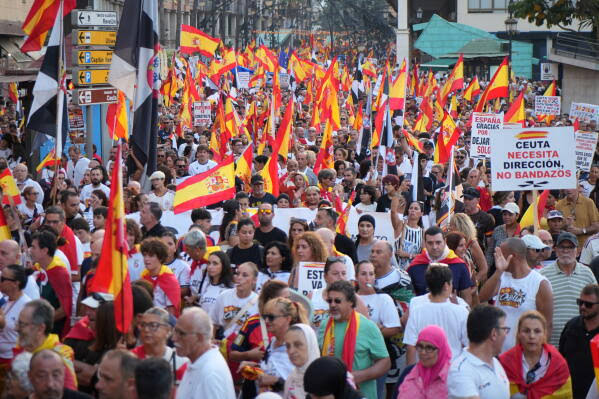
Spain’s deepening migration and security crisis in the North African enclave of Ceuta has erupted into a major political confrontation, with thousands of people taking to the streets across the country to protest the government’s handling of the unprecedented influx of migrants from Morocco.
The demonstrations, held on Wednesday, September 2, coincided with Ceuta Day, and placed Prime Minister Pedro Sánchez under renewed pressure as opposition parties accused his government of failing to protect Spain’s border and abandoning the residents of the strategically important enclave.
The protests came just hours after a Spanish National Police report raised fresh questions about the role of Moroccan security forces in the mass crossing of July 30 and 31. The report describes an extraordinary degree of “total permissiveness” by Moroccan security personnel and suggests that some migrants may have been guided towards Ceuta by Moroccan agents. However, the report does not establish that the Moroccan government ordered, planned or authorised the operation, and senior Spanish police officials have stressed that no government has been directly implicated.
The development has placed Sánchez in an increasingly difficult position: he must defend Spain’s relationship with Morocco, a critical partner in controlling migration, while answering growing domestic demands for an explanation of how tens of thousands of people were able to reach Spanish territory almost simultaneously.
More than 72,000 entered Ceuta in unprecedented July surge
The crisis began on July 30 and 31, when approximately 72,000 people crossed from Morocco into Ceuta, according to Spain’s Interior Ministry.
The scale of the movement was extraordinary for a city whose population is only around 85,000. Spanish authorities say the vast majority subsequently returned to Morocco, many within 24 to 48 hours. By early August, Spain said more than 70,000 of those who entered had already left Ceuta.
The government’s most recent official estimate before the September protests put the number still in Ceuta at approximately 5,000, including about 1,500 minors. Other estimates cited by opposition politicians and some reports have placed the number considerably higher, at around 10,000 or even more.
The crisis has also carried a devastating human cost. At least 90 people were reported to have died, many of them drowning while attempting to swim around the breakwater separating Morocco from Ceuta. Other local estimates have put the death toll above 100.
Police report puts Moroccan security forces under scrutiny
The most explosive new development is the report prepared by Spain’s National Centre for Immigration and Borders (CENIF) for the National Court.
According to Spanish media reports and agencies that reviewed the document, investigators concluded that the mass movement was unlikely to have been a spontaneous migration episode.
The report reportedly describes the operation as a planned and coordinated process, involving different stages and an organisational structure whose ultimate authorship remains unidentified. It also says there was an unusual lack of intervention by Moroccan security personnel around the border.
Investigators reportedly identified 32 Moroccan security personnel — 11 in uniform and 21 in civilian clothing — in photographs and other evidence examined as part of the investigation. Some uniformed officers were allegedly observed along routes used by migrants towards the Tarajal breakwater.
The report’s description of Moroccan police behaviour is particularly significant, referring to “total permissiveness” and a failure to make serious efforts to disperse or prevent the enormous gathering near the border. Some migrants reportedly told investigators that Moroccan officers adopted a passive attitude or even gave directions.
But there is an important distinction.
The report does not prove that Morocco’s government organised the crossing.
Spain’s Director-General of Police, Francisco Pardo, told Interior Minister Fernando Grande-Marlaska that no police report currently establishes the involvement of the Moroccan government or identifies the person or organisation responsible for the mass entry.
That distinction has become central to the political dispute.
Sánchez rejects accusation that Morocco orchestrated the crisis
Sánchez told Parliament on Thursday that there was still no concrete evidence that Moroccan authorities orchestrated the mass crossing.
He acknowledged that Moroccan police allowed people to cross during a critical period of about 10 hours on July 30, but questioned whether that reflected deliberate facilitation or simply inability or failure to control the situation.
The Prime Minister also said that neither European institutions nor diplomatic authorities had produced evidence establishing that Morocco deliberately engineered the influx.
Morocco, meanwhile, has rejected allegations that it deliberately organised or facilitated the mass movement.
The issue is particularly sensitive because Morocco claims sovereignty over Ceuta and neighbouring Spanish enclave Melilla, although Spain regards both territories as integral parts of Spanish territory.
Consequently, any suggestion that Moroccan state forces deliberately opened the border carries implications extending far beyond ordinary migration management.
A border crisis becomes a political crisis
The controversy has become a major weapon for Spain’s opposition.
The conservative People’s Party (PP) and the far-right Vox have accused Sánchez of failing to respond adequately to the crisis and of putting diplomatic considerations ahead of the security of Ceuta’s residents.
PP leader Alberto Núñez Feijóo attended the Madrid demonstration, where government estimates put the crowd at more than 50,000 people.
Feijóo accused the government of allowing a Spanish city to be overwhelmed and demanded greater accountability from Sánchez.
Vox leader Santiago Abascal went further, accusing Sánchez of acting in the interests of Morocco.
The opposition’s broader argument is that Madrid had warning signs before the mass crossing but failed to prevent the situation from escalating.
Feijóo had already called for Spain to declare the Ceuta situation a national-security emergency during the initial July crisis and urged the government to consider military deployment to reinforce the border.
Ceuta residents: “Our border must not be sidelined”
In Ceuta itself, thousands of residents marched with Spanish flags and demanded stronger border controls.
Demonstrators chanted slogans including:
“Ceuta is not for sale. Ceuta must be defended.”
Many protesters called for migrants who have no legal right to remain in Spain to be returned and for greater security support from Madrid.
The anger is not limited to questions of migration numbers. Residents say the sudden influx has placed enormous pressure on accommodation, public services, policing and the city’s already limited infrastructure.
One local resident, teacher David Hernández, described the government’s response as inadequate and delayed, arguing that Ceuta’s residents should not be treated as “second-class citizens.”
But Spain’s political opposition faces a counter-movement
The demonstrations have not been universally directed against migrants.
Left-wing groups, trade unions and civil-society organisations organised counter-protests in several Spanish cities, including Madrid, condemning what they described as racist and Islamophobic attacks against migrants.
A non-partisan citizens’ initiative known as “Por Ceuta” (For Ceuta) has gathered almost 65,000 signatures for an alternative response based on three principles: protection of the human rights of both residents and migrants, orderly return of people who have no right to remain, and stronger security measures.
This has produced an increasingly polarised debate in Spain, with one side portraying the crisis primarily as a border-security and national-sovereignty emergency, while the other warns against turning vulnerable migrants into political scapegoats.
The social-media dimension
Investigations have also uncovered evidence that social media played a significant role in mobilising potential migrants before the July crossings.
Spanish fact-checking organisation Maldita.es examined more than 1,100 Arabic-language Facebook posts referring to Ceuta and the Spanish Supreme Court’s ruling on border returns.
The investigation found that a misleading message claiming the court ruling effectively meant migrants could no longer be immediately returned from Ceuta was repeatedly circulated online. The same wording was reportedly shared more than 215 times on July 30, the day the mass crossing began.
A separate investigation identified 21 Facebook groups in which users were discussing and organising attempts to cross into Ceuta in the days before July 30. Some of the groups had very large memberships, while WhatsApp groups were subsequently used for further coordination.
Spanish authorities therefore believe that misinformation, online mobilisation and possibly organised coordination contributed to the scale of the movement.
But investigators have yet to establish who ultimately coordinated the operation.
Supreme Court ruling added another layer to the crisis
The migration surge followed a controversial Spanish Supreme Court ruling concerning the immediate return of people attempting to enter Ceuta and Melilla by swimming.
The ruling, published on July 8, clarified limitations on Spain’s ability to immediately reject people arriving by sea because the physical conditions of the border are different from those at conventional land crossings.
The ruling subsequently became the subject of extensive discussion on Moroccan social media.
Spain’s Interior Ministry moved quickly after the July crisis to install an inflatable barrier and containment buoys around the Tarajal breakwater, citing the Supreme Court ruling and the need to create physical containment infrastructure.
Government declares Ceuta a national-security matter
Faced with mounting pressure, Sánchez’s government has progressively escalated its response.
On August 25, the Spanish Council of Ministers formally declared the situation in Ceuta to be “of interest for national security” and established a central coordinating authority — effectively a single command structure — involving the national government, Ceuta’s administration, the intelligence services and other relevant institutions.
The government has also increased temporary accommodation capacity, strengthened migrant identification and screening operations and deployed additional police personnel.
By late August, Spain said accommodation capacity had increased from roughly 500 places to more than 3,400, while more than 1,600 police officers had been deployed in connection with the crisis.
Additional temporary humanitarian sites have also been established in Ceuta to accommodate people still in the city.
€309 million promised as pressure mounts
Sánchez has also pledged substantial financial assistance to Ceuta, with the central government promising approximately €309 million to help address the consequences of the crisis.
The government insists that it has not abandoned Ceuta and says its response has involved security, humanitarian assistance, migrant identification, cooperation with Morocco and measures to restore normality.
However, opposition parties and many local residents argue that the government’s intervention came too late and remains inadequate.
The Morocco dilemma
At the heart of the crisis lies Spain’s complicated relationship with Morocco.
Madrid depends heavily on Rabat’s cooperation in controlling migration across the Strait of Gibraltar and along Spain’s North African borders. Morocco is also a major strategic partner for Spain on security, trade and counter-terrorism.
That makes any direct accusation against the Moroccan government diplomatically dangerous.
Yet the latest police findings have created an uncomfortable contradiction for Sánchez.
On one hand, Spanish investigators describe an extraordinary degree of passivity among Moroccan security personnel and identify Moroccan officers around the routes used by migrants.
On the other, Sánchez insists there is no evidence proving that the Moroccan state ordered or organised the operation.
That gap between “Moroccan security forces were unusually permissive” and “Morocco orchestrated the crisis” is now at the centre of Spain’s political battle.
A second controversy: who knew what, and when?
The latest development has opened another potentially damaging question for the Sánchez administration.
On Thursday, Sánchez demanded an explanation as to why the CENIF report commissioned by a National Court judge was not passed up the police chain of command or to the Interior Ministry, despite its potentially significant national-security implications.
The Prime Minister said the circumstances surrounding the report would have to be explained.
That means the political controversy is now no longer simply about what happened at the Ceuta border, but also about what Spanish authorities knew before and after the crossings and how that intelligence was handled.
What remains unanswered
Several crucial questions remain unresolved:
1. Who organised the mass movement? Spanish investigators believe the operation was planned rather than spontaneous, but its ultimate intellectual and operational authorship has not been established.
2. Did Moroccan security forces deliberately facilitate the crossing? The police report strongly suggests unusual permissiveness and possible guidance by individual Moroccan officers, but this has not been established as a decision by the Moroccan government.
3. Was the Spanish government adequately warned? Investigators say CENIF had identified an increased risk of a mass entry before the July 30 operation, raising questions about whether sufficient preventive measures were taken.
4. How many migrants actually remain in Ceuta? The Spanish government has put the figure at around 5,000, while other estimates have been significantly higher.
5. Will the crisis damage Spain-Morocco relations? For now, Sánchez appears determined to avoid directly blaming Rabat. But mounting domestic pressure could make that position increasingly difficult to sustain.
A crisis with no easy exit
The Ceuta crisis has therefore evolved from a sudden migration emergency into a three-dimensional Spanish crisis involving border security, humanitarian protection and international diplomacy.
For Ceuta’s residents, the immediate concern is restoring security and normal life.
For migrants, the challenge is survival, legal status and access to humanitarian protection.
For Sánchez, the political stakes are considerably broader: he must demonstrate that Spain’s borders are secure without provoking a diplomatic confrontation with Morocco, while simultaneously countering accusations from the PP and Vox that his government failed to protect a Spanish territory.
And now, with a police investigation pointing to organised activity and unusual Moroccan security-force behaviour, the central question has changed.
The issue is no longer simply how 72,000 people entered Ceuta. It is who enabled the movement, why it happened, what Spanish authorities knew beforehand — and whether the July border breach was a spontaneous migration surge or something more deliberate.
For now, the evidence points toward organisation and extraordinary permissiveness, but not yet to a proven decision by the Moroccan government to engineer the crisis. That distinction is likely to remain at the centre of Spain’s political and diplomatic storm in the days ahead.