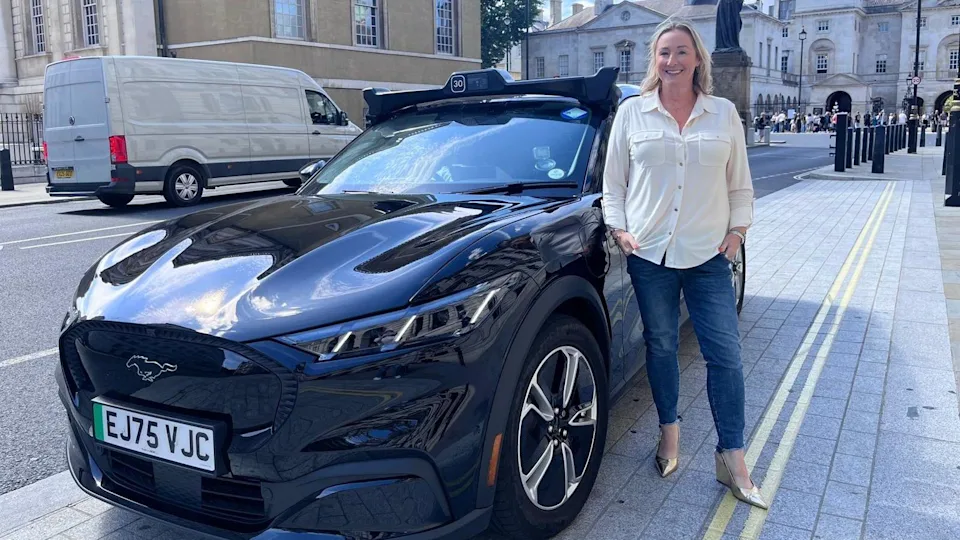
BY OLUWATOBILOBA AREMU, LONDON — Britain has entered a new era of urban transport as Uber and British autonomous-driving company Wayve launch the country’s first publicly available autonomous ride-hailing service in London.
From September 2026, Londoners requesting an UberX, Uber Electric or Uber Comfort journey can be matched with an all-electric Ford Mustang Mach-E fitted with Wayve’s artificial-intelligence driving system. The service is being introduced under a supervised model, meaning a trained, Transport for London-licensed private-hire driver remains in the vehicle and can intervene whenever necessary.
The launch represents a significant milestone for Britain’s autonomous-vehicle industry — but it is not yet a fully driverless taxi service.
Uber describes the initial operation as a carefully controlled first step towards a future in which autonomous vehicles and conventional human-driven cars operate alongside each other.
More than 140,000 Londoners have already opted in to increase their chances of being matched with one of the autonomous vehicles.
A robotaxi — but with a human ready to take over
For passengers, the experience begins much like an ordinary Uber journey.
A customer requests an eligible Uber trip through the app. If a Wayve autonomous vehicle is available nearby, the passenger can be offered the autonomous option and is free to accept it or switch to a conventional Uber vehicle before the car arrives. There is no additional charge for choosing the autonomous ride.
Once inside, passengers can unlock the vehicle and begin their trip through the Uber app.
But unlike fully autonomous robotaxis already operating in parts of the United States, London’s initial vehicles have a trained safety driver sitting in the driver’s seat.
The driver is there to supervise the Wayve AI Driver, monitor the road and take control if necessary.
That distinction is crucial.
The September launch is therefore better described as supervised autonomous ride-hailing, rather than a completely driverless taxi operation.
What it is like to ride in one
The first British journalists allowed to experience the service as passengers reported an experience that was largely similar to being driven by a competent human driver.
The autonomous Ford navigated London’s busy streets, traffic lights, roadworks, cyclists and other road users without continuous human intervention.
At one point, however, the safety driver intervened when the vehicle encountered a potentially hazardous situation involving the rear doors of a parked van appearing to open into the car’s path.
The vehicle braked sharply, an internal warning sounded and the safety driver took control.
Wayve subsequently indicated that the intervention was the safety driver’s decision and that the company’s system was confident it could have handled the situation itself.
The incident nevertheless provided an important reminder: the technology is being introduced cautiously precisely because London’s roads present situations that can be unpredictable even for experienced human drivers.
How Wayve’s technology works
The autonomous vehicles are Ford Mustang Mach-E electric cars equipped with Wayve’s AI Driver technology and an array of cameras, radar and other sensors.
Rather than relying exclusively on detailed, pre-programmed high-definition maps and thousands of manually coded instructions, Wayve says its system uses artificial intelligence to interpret its surroundings and make driving decisions in real time.
Wayve’s approach is based on an “end-to-end” AI driving system that learns from driving experience and is designed to adapt to complex environments.
The company’s technology has been developed and trained on London’s roads since Wayve was founded in the capital in 2018.
That is particularly significant because London is one of the world’s most complicated driving environments, with:
– dense and constantly changing traffic;
– cyclists and motorcyclists;
– pedestrians crossing unexpectedly;
– narrow residential streets;
– buses and taxis;
– roadworks;
– temporary traffic restrictions;
– unusual junctions and roundabouts;
– emergency vehicles;
– and the distinctive behaviour of London’s human drivers.
Wayve argues that its AI approach can learn to deal with these conditions without requiring every possible situation to be manually programmed.
Where can passengers take the robotaxi?
At launch, autonomous Uber journeys are available across London, excluding airports, according to Uber’s latest announcement.
The service is initially being operated with a small fleet, allowing Uber and Wayve to collect real-world experience while regulators, engineers and safety teams monitor performance.
The number of vehicles is expected to increase progressively as demand, technological readiness and regulation permit.
The companies have deliberately adopted a gradual expansion strategy rather than attempting an immediate large-scale replacement of conventional Uber vehicles.
How much does a robotaxi cost?
For passengers, one of the most striking aspects of the launch is that there is no special premium for the autonomous technology.
Wayve vehicles can be offered to customers requesting UberX, Uber Electric or Uber Comfort, with the fare displayed in the app.
Uber says passengers can choose whether to accept the autonomous vehicle or switch to a conventional ride before the car arrives.
That pricing strategy could prove important.
If autonomous vehicles eventually become capable of operating without safety drivers, their economics could potentially be very different from conventional private-hire vehicles because operators would no longer have to pay a driver for every journey.
However, that future has not yet arrived in London.
Why the London launch matters
The significance of the Wayve-Uber partnership extends beyond one new Uber product.
It represents Britain’s first public autonomous ride-hailing deployment and gives a British technology company the opportunity to demonstrate its system in one of the world’s most challenging urban environments.
Wayve CEO and co-founder Alex Kendall described the company’s work as a generational technological race, while Uber’s global head of autonomous mobility and delivery, Sarfraz Maredia, said autonomous technology would develop alongside conventional human-driven Uber services.
Uber has also been expanding its autonomous-vehicle partnerships internationally. The company says its AV partnerships have the potential to put large numbers of autonomous vehicles onto its global platform in coming years.
London becomes a battleground for autonomous-vehicle companies
The Uber-Wayve launch is unlikely to remain uncontested.
Waymo, the autonomous-driving company owned by Alphabet, Google’s parent company, has already been testing autonomous vehicles on London’s roads.
Waymo has extensive experience operating commercial driverless services in the United States, including in cities such as San Francisco, Phoenix and Austin.
Unlike London’s current Wayve-Uber operation, Waymo’s long-term objective is to operate vehicles without a human driver.
Other companies, including Chinese technology giant Baidu, are also looking at the UK market.
The emerging competition means London could become an important European testbed for competing approaches to autonomous driving.
Why Britain is moving cautiously
Despite the excitement surrounding the Uber-Wayve launch, Britain’s regulatory authorities are deliberately taking a cautious approach.
The Automated Vehicles Act 2024 established the legal foundation for a comprehensive framework governing self-driving vehicles in Great Britain.
The government says the full implementation programme is aimed at 2027, with safety at the centre of the system.
In June 2026, the Department for Transport published a consultation on proposed safety principles for automated vehicles.
Under the proposed framework, an autonomous vehicle must demonstrate a high level of safety before being authorised to operate without human control. The government says the safety bar should be higher than that achieved by the average human driver.
This is one reason the current Uber-Wayve deployment retains a human safety driver.
The law is preparing for truly driverless taxis
Britain’s regulatory framework goes further than simply permitting vehicles with safety drivers.
The government’s proposed Automated Passenger Services regime is intended to create a legal route for commercial passenger services operating without a human driver.
The Department for Transport says the system is designed to accommodate both trials and future commercial deployments of vehicles capable of carrying passengers without a driver.
Local authorities and transport bodies will also have an important role. Proposed deployments require local consent, with traffic authorities consulted about their potential effects on roads and communities.
The government expects the broader legal framework under the 2024 Act to be fully implemented in the second half of 2027.
That makes the present Wayve-Uber launch an important bridge between experimental autonomous driving and the eventual arrival of genuinely driverless commercial services.
Safety remains the biggest question
The technology may be impressive, but regulators face a fundamental problem:
How safe is safe enough?
A human driver can make intuitive decisions that are difficult to encode into conventional rules or anticipate through artificial intelligence.
Consider an ambulance approaching a traffic jam.
A human driver may mount the kerb, cross a line or squeeze into a narrow space to create an emergency corridor.
An autonomous vehicle must determine not only that an emergency vehicle is approaching but also what action is legally permissible, physically safe and socially appropriate in that particular situation.
The problem becomes even more complicated in a city as densely populated as London.
Other questions include:
– How should an autonomous vehicle react to an aggressive human driver?
– What happens when a cyclist suddenly moves into its path?
– How should it negotiate ambiguous road markings?
– Can it understand a police officer’s hand signal?
– What happens when road signs conflict with temporary instructions?
– How does it respond to flooding, snow or damaged roads?
– Who is responsible when the AI makes the wrong decision?
– Who bears liability after a collision?
– What happens when the vehicle loses connectivity?
– Can hackers interfere with an autonomous vehicle?
These are not theoretical concerns. They form part of the wider challenge regulators must resolve before allowing large fleets of vehicles to operate without human supervision.
What happens to Uber drivers?
Perhaps the most politically sensitive question is the future of Britain’s taxi and private-hire workforce.
Trade unions and driver representatives have warned that autonomous vehicles could eventually threaten thousands of driving jobs if fleets become sufficiently reliable and commercially competitive.
The government’s position is that autonomous technology could create new skilled employment and investment opportunities, while improving mobility for people who cannot drive.
But for professional drivers, the transition raises legitimate concerns about employment, income and the future structure of the private-hire industry.
The likely scenario is not an overnight disappearance of human drivers.
Uber itself says it expects human drivers to remain an important part of its London operation for a long time, even as autonomous vehicles become more widespread.
The more immediate question is whether the two models can coexist — and for how long.
The economics could eventually change everything
The current robotaxi costs passengers roughly what a conventional Uber trip costs because the vehicle is still part of a supervised operation.
But if regulators eventually authorise truly driverless vehicles, the economics could change dramatically.
A driverless vehicle could potentially:
– operate for longer hours;
– reduce labour costs;
– reposition itself without a driver;
– increase vehicle utilisation;
– potentially lower fares;
– and allow companies to operate much larger fleets.
At the same time, autonomous fleets would generate new costs involving software, sensors, maintenance, remote assistance, insurance, cybersecurity, charging infrastructure and regulatory compliance.
Whether robotaxis ultimately become significantly cheaper than conventional taxis therefore remains an open question.
London’s experiment begins
The first Uber-Wayve vehicles represent only a small beginning.
The cars are still supervised.
The fleet is limited.
The technology remains under intense observation.
And Britain’s full legal framework for large-scale autonomous passenger services is still being implemented.
Yet the significance of September 2026 should not be underestimated.
For the first time, an ordinary member of the British public can open an Uber app, request a journey and potentially find that the car arriving to collect them is driving itself.
There is still a human sitting behind the wheel.
But the person making most of the driving decisions is no longer necessarily human.
And that makes London’s first robotaxi service less the arrival of the driverless future than the moment Britain has officially begun the transition towards it.