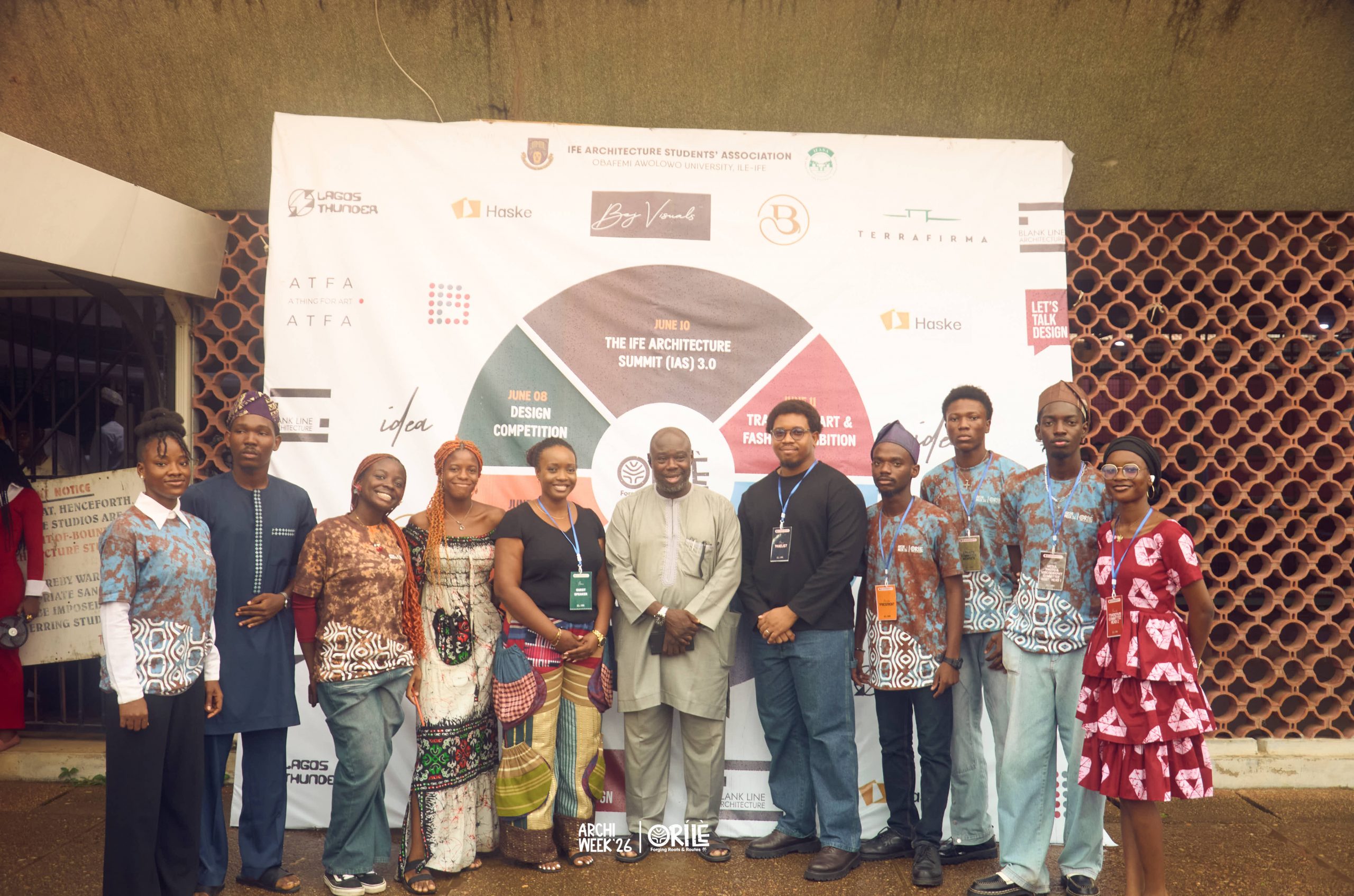
The Department of Architecture at Obafemi Awolowo University recently witnessed a remarkable convergence of intellectual inquiry, cultural reflection, professional engagement, and creative expression as the Ife Architecture Students’ Association (IFASA) hosted ArchiWeek 2026, a week-long academic and social programme that reaffirmed the enduring relevance of indigenous knowledge systems in contemporary architectural practice.
Widely regarded as one of the most prominent student-led architecture events in Nigeria, this year’s edition distinguished itself not merely through the breadth of its activities but through the depth of its intellectual vision. Held under the theme *“Oríl̀ẹ: Forging Roots and Routes,”* the event explored the relationship between architectural heritage and future development, challenging participants to reflect on how place, culture, history, and identity can inform sustainable design solutions in an increasingly globalised world.
At the heart of the theme was a tribute to Professor C. O. Osasona, whose scholarly contributions to vernacular architecture and cultural heritage preservation have significantly influenced architectural discourse in Nigeria and beyond. By dedicating ArchiWeek 2026 to her legacy, the student leadership, popularly known as The Forge Administration, sought to stimulate critical conversations around architecture’s responsibility to local contexts while embracing global possibilities.
The week commenced on June 6 with a vibrant Sports Festival, an event designed to foster camaraderie, healthy competition, and community spirit among students. Participants competed in football, table tennis, relay races, sprint events, and other sporting activities, with Red House eventually emerging as overall champions. The event set a tone of energy and collective participation that would define the week.
Design rigour took centre stage during the IFASA National Design Competition, held on June 8. The competition, themed Architectural Palimpsest, attracted entries from architecture schools across Nigeria, including representatives from the University of Nigeria, Nsukka, University of Ilorin, Bowen University, Federal University of Technology Akure, Federal University of Technology Minna, and Ladoke Akintola University of Technology.
The competition introduced participants to the concept of architectural palimpsest—a framework encouraging designers to engage with layers of history, memory, and identity within the built environment. Out of 17 competing teams, seven advanced to the final jury stage.
Following a highly competitive evaluation process, Team Ireti from Obafemi Awolowo University secured first place, while Team Ladipo from LAUTECH and Team Irii from FUT Minna claimed second and third positions respectively. In a move widely applauded by participants, all shortlisted teams received financial rewards, reflecting IFASA’s commitment to recognising excellence and encouraging wider participation in architectural innovation.
On June 9, the focus shifted from design studios to cultural heritage through the Origin of Flavours Cooking Competition and Architectural Trivia Session. Students showcased indigenous culinary traditions while engaging in intellectually stimulating architectural quizzes.
The event highlighted a growing recognition that architecture extends beyond buildings and physical structures to encompass the social, cultural, and experiential dimensions of human life. Through food, conversation, and knowledge exchange, participants explored how cultural identity influences both everyday experiences and architectural thinking.
One of the most anticipated highlights of the week was the Ife Architecture Summit 3.0, held on June 10 within the department’s M.Sc. Studio.
The summit assembled leading professionals to examine contemporary challenges and opportunities in African architecture. Distinguished architect Olayiwola Papa Omotayo delivered the keynote address titled “From Roots to Routes: How African Architecture Travels and Returns,” where he explored the dynamic relationship between local traditions and global architectural influences.
Also speaking at the summit was Arc. ERUKE Oyinvwin Pamela, who presented a session on “Building Systems That Scale: Architecture as Strategy in the Nigerian Context.” The programme further featured a panel discussion with artist and creative director Ofununochukwu Rufus Nwoko, focusing on the future of African architectural heritage and preservation.
Participants described the summit as intellectually stimulating, noting that it raised critical questions about identity, sustainability, urbanisation, and the role of architects in shaping inclusive societies.
The week’s artistic dimension came alive during the Art and Fashion Exhibition and Trade Fair, organised under the thought-provoking theme “Where/What Do We Call Home?”
The exhibition transformed the department into a vibrant hub of artistic expression and entrepreneurship, featuring fashion displays, visual arts, jewellery, culinary exhibitions, and creative enterprises.
A particularly memorable aspect of the event was the participation of six students from OAU International School, whose artworks were displayed alongside those of university students and professional creatives. Observers described the initiative as an inspiring demonstration of the importance of nurturing artistic and cultural consciousness from an early age.
The concluding event, Breakfast With An Alumnus, marked the beginning of what organisers hope will become a lasting institutional tradition.
The inaugural edition welcomed Arc. Eromosele Anetor, a distinguished alumnus of the department and founder of Anetorplus. Through candid conversations, personal reflections, and professional mentorship, he shared insights from nearly three decades of architectural practice with final-year undergraduate and postgraduate students.
Participants described the session as enlightening and inspiring, citing the opportunity to engage directly with an accomplished professional who once occupied the same classrooms and studios.
For many attendees, the programme represented more than a networking opportunity; it symbolised the strengthening of intergenerational connections essential to the growth of the architectural profession.
As ArchiWeek 2026 drew to a close, it became evident that the programme had achieved far more than a routine calendar of activities. By combining scholarship, competition, cultural reflection, creativity, mentorship, and community engagement, IFASA successfully created a platform that challenged conventional notions of architectural education.
More importantly, the week reinforced a central message: that the future of African architecture cannot be separated from its cultural roots. In celebrating heritage while encouraging innovation, ArchiWeek 2026 demonstrated that meaningful architectural progress emerges not from abandoning tradition but from understanding, refining, and reimagining it.
For students, academics, and practitioners who participated, Oríl̀ẹ: Forging Roots and Routes was more than a theme. It was a call to action—a reminder that the paths architects create for the future must remain firmly connected to the foundations from which they emerge.
With new traditions established, meaningful conversations initiated, and fresh networks forged, ArchiWeek 2026 may well be remembered as one of the most intellectually impactful editions in the history of IFASA, laying roots that promise to shape architectural routes for years to come.