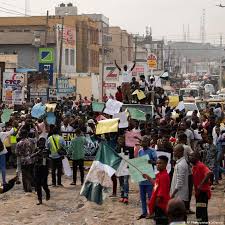
Lagos, Nigeria — Nigeria, once hailed as Africa’s economic powerhouse, is now grappling with an unprecedented economic crisis that has thrown millions into poverty and brought the nation to the edge of despair. The prices of essential goods—food, fuel, and medicine—have soared to levels unimaginable just a few years ago, pushing many Nigerians into a daily struggle for survival.
Economic Freefall:
Only two years ago, Nigeria was Africa’s largest economy, but it is now projected to fall to fourth place. The national currency, the naira, has lost nearly 70% of its value against the dollar in the past year alone, exacerbating the crisis. Inflation is rampant, and the cost of living has skyrocketed, with even basic necessities now out of reach for a significant portion of the population.
In the streets and markets, the desperation is palpable. Unions are striking across the country, demanding a livable wage, as salaries have stagnated at around $20 a month. Hospitals are overwhelmed, not just by the sick but by the malnourished, as calcium deficiencies—once a rarity—are now common. In northern Nigeria, the Murtala Muhammed Specialist Hospital in Kano is seeing multiple cases of hypocalcemia daily, a stark indicator of the deepening food crisis.
Roots of the Crisis:
The current economic turmoil is largely attributed to two significant policy changes implemented by President Bola Tinubu, who took office 15 months ago. The partial removal of fuel subsidies and the decision to float the naira were meant to stabilize the economy and attract foreign investment. However, these measures have instead led to rampant inflation and widespread poverty, leaving many Nigerians worse off than before.
Nigeria, a nation of over 200 million people, is known for its entrepreneurial spirit and resilience. For decades, Nigerians have found ways to survive despite the absence of basic services that governments typically provide. They generate their own electricity, source their own water, and even negotiate with kidnappers to secure the release of abducted family members. But today, their resourcefulness is being tested like never before.
The Human Cost:
In Ibadan, southwestern Nigeria, the Afolabi family’s descent into poverty began when they had to sell their electric tuk-tuk taxi to cover medical bills. What was once a means of livelihood quickly vanished, leaving the family struggling to survive on the occasional construction jobs Babatunde Afolabi could find. With cassava—the cheapest staple in Nigeria—tripling in price, the family now subsists on a meager diet of biscuits, bread, and peanuts.
Nigeria’s economic woes are further compounded by its heavy reliance on imported petroleum products, despite being one of the world’s largest oil producers. Years of underinvestment and mismanagement have left the country’s refineries in disrepair, forcing Nigeria to import nearly all its gasoline. The removal of fuel subsidies has only deepened the crisis, driving up transportation costs and making everyday goods even more expensive.
Life on the Edge:
For many Nigerians, the removal of fuel subsidies was the final straw. The once-dependable middle class, like hospital worker Salisu Garba, is now struggling to make ends meet. Garba, who supports 17 family members on a $150 monthly salary, has had to take on multiple jobs just to survive. He sold his car when gas prices became unaffordable and now relies on a tuk-tuk to get to work. In the evenings, he runs a small pharmacy, but with few customers able to afford medicine, sales are dwindling.
The situation is so dire that deadly stampedes have occurred during the distribution of free or discounted rice by the government. In March, seven students were killed at a university in Nasarawa State when a crowd surged during a rice giveaway.
President Tinubu has promised to create a million jobs and quadruple the size of the economy within a decade, but details on how these ambitious goals will be achieved remain unclear. The International Monetary Fund (IMF) recently reported that the government has quietly resumed subsidizing fuel and electricity, though no official announcements have been made. The lack of transparency and coherent economic strategy has left many Nigerians feeling abandoned by their leaders.
The Tapping Craze:
Amidst the economic despair, a new trend has emerged—crypto-mining games that promise income for users who tap on their smartphone screens. In a country where the national currency is rapidly losing value, desperate Nigerians are turning to digital currencies as a potential lifeline. Children tap under their desks at school, mourners tap at funerals, and people tap as they pray in mosques and churches, all in the hope of earning a few dollars.
Rabiu Biyora, a 39-year-old from Kano, has become the king of tapping. With five foldable phones and a following of tech-savvy young men, Biyora has amassed over 2.7 billion taps on the TapSwap app. While he profits from the tapping craze, many others are left chasing the illusion of financial stability in a rapidly deteriorating economy.
A Community Strained:
Nigeria’s tradition of community support and charity is also under strain. At Freedom Radio station in Kano, the number of people seeking help with medical bills, school fees, and other emergencies has surged. But the generosity of listeners has dwindled, as even those who once gave freely are now struggling themselves.
Hospital worker Garba notes that the number of patients in his hospital has nearly halved in recent months—not because the population is healthier, but because many can no longer afford the 20-cent bus ride to get there.
As Nigeria continues to navigate its worst economic crisis in a generation, the resilience of its people is being stretched to the breaking point. Without swift and decisive action from the government, the outlook remains grim, with millions more likely to slip into poverty.
A critical and further investigation of a report published by The New York Times – by Oluwatobiloba Adeoye-Aremu, UK Correspondent, Inquisitiores News.